 |
| Britain 2013 |
Why Is the British Constitution Unwritten?
Answer
According to Ask Jeeves the archetypal English gentleman's gentleman the:-
"British Constitution is unwritten because it has no single document which states principles and rules of a state. However, it clearly sets out how political power is allocated and where it is legally located. It also defines composition and powers of the main offices and institutions of the state."
"British Constitution is unwritten because it has no single document which states principles and rules of a state. However, it clearly sets out how political power is allocated and where it is legally located. It also defines composition and powers of the main offices and institutions of the state."
The Failure of the Neoliberal Political Consensus
In the first part of this blog I suggested that the cultural fabric of the countries that comprise Great Britain have been stretched thin by repeated instances of corruption and malfeasance that has invalidated the social contract upon which represenatative democracy depends. This I would suggest is a significant departure from the consensus politics of the British post-war welfare state period roughly 1945-1973, but it does represent a renewed consensus in British politics and indeed in global politics, which brings with it a whole new comstellation of contradictions.
There is of course nothing unique in Britain's current situation, it is shared to some lesser or greater degree by the wider English speaking world (the Anglosphere) and beyond it ascross many first world post-industrialised countries that are signed up to Global NATO..
On the world stage we see the clash of interest groups and hydrocarbon wars reminiscent Britain's two Opium Wars with China in the mid-19th century. Gangsterism in foreign policy is hardly a recent phenomenon, however widespread information about its machinations within the global community is certainly a 21st century development.
On the world stage we see the clash of interest groups and hydrocarbon wars reminiscent Britain's two Opium Wars with China in the mid-19th century. Gangsterism in foreign policy is hardly a recent phenomenon, however widespread information about its machinations within the global community is certainly a 21st century development.
In 2008 the Great Crash that underlined the inherent instability of capitalism changed the world forever.
By and large both the mainstream corporate media and professional economists not only missed the significance of this cataclysmic event... but continue to remain in denial five years on. Things are changing however as the Guardian reported in October this year:-
"Economics undergraduates at the University of Manchester have formed the Post-Crash Economics Society, which they hope will be copied by universities across the country. The organisers criticise university courses for doing little to explain why economists failed to warn about the global financial crisis and for having too heavy a focus on training students for City jobs." http://www.theguardian.com/business/2013/oct/24/students-post-crash-economics
The article goes on to cite Paul Krugman, a Nobel prize winner and professor at Princeton university who has also attacked the complacency of economics education in the US. The Guardian piece makes reference to an article for the New York Times from 2009 in which Krugman wrote:
"As I see it, the economics profession went astray because economists, as a group, mistook beauty, clad in impressive-looking mathematics, for truth."
That may well have been the folly of the economists but closely related to this is the folly of the politicians who have made a living out of impressive-looking mathematics if rarely it must be said are they mistaken for beauty.
The political malaise that is now confronting Britain goes much deeper than post-crash economics however, it goes to the very heart of the current legitimation crisis that affects the social fabric of this country and progressively dismantles it from within, as well as from without. During the mid 1970s German political theorist Jurgen Habermas published his book Legitimation Crisis in English [1975] (originally Legitimationsprobleme im Spätkapitalismus 1973) in which in a nutshell:-
He suggests that people expect governments to intervene successfully in the economy to try and ensure economic prosperity. Failure to succeed can cause the validity of the capitalist system to be questioned, thus undermining its legitimacy. Read more: http://www.answers.com/topic/legitimation-crisis#ixzz2oUX9gA2S
 |
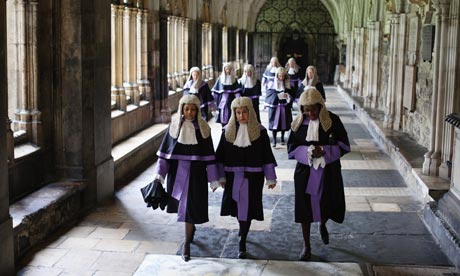
| Mary Poppins, a Santa Clause convention?.....No its the British judiciary in action |
Habermas building upon the post-marxian traditions of the Frankfurt School of Critical Theory proposes a form of Systems Theory in which not only solutions are generated, but also contradictions arise from the nature of capitalism and the social relationships it creates. In Britain this is especially associated with the class system, but also has echoes in the 17th century political upheavals out of which emerged a United Kingdom which presently has no king and is increasingly disunited. Nowadays the UK stands for the Untied Kleptocracy as political devolution undermines the foundations of the failing marriage of convenience between England and the Celtic fringe, meanwhile gangsterism runs rife in the ruling establishment of bankers, landowners, media barons and Euro-Royalty. As the latter point makes clear the lands of the British archepelago are not alone in this realignment of global power and influence, but the conditions that pertain here makes the body politic more brittle than some of our continental cousins experience. Sitting at the pinacle of the long defunct British Empire means that the apex of the UK social pyramid has further to fall than in some of our neighbours, those restructuring countries of continental Europe and the former vassal states of the so-called British Commonwealth.
Britain's unwritten constitution which worked well enough throughout the repeated consensuses that have characterised British politics for more than a century, but which now fails to give us any safeguards and its vaunted flexibility has no give left in it as the British government becomes increasingly a parody of itself.
The Mother of Parliaments has become clinically obese and irretrievably demented in her dotage, her institutions are similarly bloated and confused... as we enter 2014 a cold wind of change is inflating the wind sock (or is it the support stocking?) .... on the windswept deck of Airstrip One.
Something has to change before very much longer because the situation as it pertains in England and the other countries of the British Isles is unsustainable...but no worries, it will.... in due course.

You nailed the current situation in the Anglosphere quite well, AA. It is becoming more and more clear to me that what happened in the Crash of 2008 was a paradigm shift--one that left no former paradigm available for a restoration of the old economic order of quick recessions in the US of A and rising living standards for ALL income earners, something which started to go wrong in 1973 with the 'price shock' of rising oil prices from the OPEC governments.
ReplyDeleteThe whole point which our leaders should have learned is that all major economic sectors have to be regulated by government ,while government agencies are regulated in turn by the voters, the media and (hopefully) the odd honest politician or two.
While we don't have a parade of colorful and slightly daffy Judges coming in out of the rain in Washington as you find in "cheery ol' '" Westminster, the problem of the uncomprehending or outmoded poiticial/judicial elite is just as acute in many respects.
A written constitution has its advantages, but when your Supreme Court has four or five borderline reactionaries on it, the thing is apt not to be able to keep up with the power of the multinational kleptocracy.
One major problem I feel is that the trappings of power in the Greco-Roman splendour of Washington DC itself make people in high places feel more in touch with the varnished past than with the shifts of power that ordinary people face out in the hustings. We have a GOP Congress which feels that there is no need to extend unemployment benefits into the New Year for those who have drawn them for more than 27 weeks. This will only create greater hardships, but the old Victorian mantra of "give the poor too much and they won't want to work" still carries some weight with Republicans and right-libertarians. The Democrats know better (most of them) but still budget deals are made in a bipartisan manner that lack empathy. To me, the lack of union power in the States makes it easier to overlook the needs of people placed in the extraordinary situation of being unable to find a job despite being able-bodied and willing to apply to hundreds of places for work. We shall see how our political elite in the USA make up for this, or will they indeed continue to show callousness and disregard, sowing the seeds of their own irrelevance to many of those they pretend to represent.
I think you are right about a paradigm shift Doug and the Greco-Roman Washington you mention looks back to its mentors and is just like them sustained by slavery. Slavery has in recent times been 'rediscovered' but it never really went away. Indentured European servants were every bit as much in slavery as the negro plantation workers were as slavery became big business in the transatlantic trade.
ReplyDeleteThe trappings of power in classical settings do tend to detach the latterday prince from the populous as a whole I think. It is part of the theatricals of state that denies political power to the people and enshrines administrations in pompous grandeur. Constantly surveilled bedazzled consumers are treated to a light show that is the celebtocracy where they learn not to ask any important questions, or at least that's the plan anyway, but it is a fatally flawed plan Whatever, it's all about slavery either economic or physical.I think Doug.
Hi aaron, as usual you cover so much its hard to know where to start.....I know many people would prefer a written constitution, and I can see why, but I've always been a bit put off the idea. I think its the way the American constitution is quoted line for line to justify owning unlimited arms or not paying tax or not having a system of universal health care etc etc.It just seems that a written constitution allows no space for a change in circumstance or a change in time. When I think about it theoretically, I think we should all be entitled to a written constitution, but in practice our unwritten constitution seems to work at least as well as many written constitutions. We don't seem to have any less rights than people in other countries, except of course that as you say; the universal system of capitalism is a destructive force where ever you live and what ever type of constitution you may or may not have. Capitalism does 'contain the seeds of its own destruction', he didn't get every thing right but look around the world today and its pretty obvious he got that one right. Thanks for another interesting read :-)
ReplyDeleteThanks Loretta. The British constitution rests upon two pillars I think - parliamentary sovereignty and the rule of law. Although it is 'unwritten' the Constitution of the UK is actually written in numerous legal documents of one sort or another. The grandaddy of them all is the Royal prerogative that authorises parliament to govern on behalf of the monarch.
DeleteIn reality I think our 'unwritten constitution' is a myth, especially now that a lot of it is written by the European Union anyway.
I take your point though about the risks of becoming hidebound by a written constitution, but for me these are balanced by the risk of the law becoming irrational, where the only check is politically motivated parliamentary scrutiny.
Politicians change our constitution all the time with legislative acts of parliament that means our human rights have had to be codified under the European Convention on Human Rights and as domestic law in the form of the Human Rights Act (1998). This is why extreme rightwing Tory politicians can threaten to repeal human rights legislation in the UK (as they currently are) in ways impossible in other member states, precisely because they do have written constitutions which are intended to stand above politics and the machinations of the state.
So really I think the unwritten constitution is something of a sham, it is written and increasingly so by the EU, so I think it is a bit of a pose really.... but one that could leave us vulnerable to the whims of politicians and the condescension of the crown, neither of which am I completely happy with I must confess.
Thanks again for your comments Loretta, they are as ever - very welcome :-)